
“In Latvia, more than 60% of people live in apartment buildings, and installing electric vehicle charging stations at these locations will be a major challenge. To promote much faster adoption of electric vehicles and the rollout of charging infrastructure, close cooperation between various companies and local governments will be necessary. Currently, the share of electric vehicles in Latvia is negligible; therefore, given the targets set by the European Union, much faster growth is needed. “To facilitate this, regular coordination of actions and perspectives is needed,” emphasized Armands Gūtmanis, founder of the Latvian Climate Neutrality Cluster 2050, during the seminar.
As the number of electric vehicles increases and the charging network expands, changing user habits will be a crucial task, emphasized Gatis Arājums, Product Development Manager for the Baltic States at Schneider Electric: “Latvia has a large number of fast-charging networks, but experience shows that users most often charge their cars where they are parked for the longest time—at home, at work, or at a supermarket. It is also very important to educate residents about which charging equipment is suitable for home use. A key issue, for example, will be how to track vehicle charging in an apartment building for each resident or visitor.”
“Schneider Electric” manufactures some of its charging equipment in Riga, but the company’s goal is to ensure that all equipment is manufactured and tested in the Latvian capital starting in 2024, which is why the factory is currently being expanded, a company representative said.
Kārlis Mendziņš, head of the charging network operator “Eleport Latvia,” explained during the seminar that the company faces four major challenges. These are establishing connections, the location of charging infrastructure, charging solutions, and public awareness.
“Although there is generally sufficient capacity in Latvia, there are certain locations in the country where establishing connections is difficult, for example, when planning charging stations outside of cities. When choosing a location for a charging station, several key factors must be considered; for example, in supermarket parking lots, these include distance from the entrance, parking lot layout, and parking space width. When considering charging solutions, however, the preferences and habits of potential users must be taken into account. It is essential to ensure convenient payment options, which is why the company plans to introduce the ability to pay with payment cards in the near future. “To dispel the myths and doubts prevalent in society regarding electric vehicle charging, we are placing a strong emphasis on education,” noted the company’s CEO.
Speaking about the ability to respond to a sharp increase in demand, Gunārs Valdmanis, Director of the Energy Market Department at the Ministry of Climate and Energy, expressed confidence that Latvia’s power system is ready for the increase in consumption driven by electric vehicles. He explained that, historically, Latvia’s electricity grids have been capable of supporting consumption of around 10 terawatt-hours per year, but annual consumption has now stabilized at 7.3 terawatt-hours. The actual grid load is well below the nominal capacity it can reach, so the existing infrastructure is sufficient to meet demand. Meanwhile, the growth in the use of electric vehicles is not so rapid that the infrastructure cannot keep up.
As the use of electric vehicles increases, local governments must address the issue of providing public charging stations. Jānis Andiņš, Senior Project Manager for Transportation Planning at the Riga City Council’s City Development Department, reported that the development of the concept for Riga’s electric vehicle charging network is nearing completion. Taking into account projections for the number of electric vehicles, the city aims to provide 3,400 public charging points by 2030 and 10,800 by 2035.
“The municipality plans to develop 15% of all charging stations on city streets, with the remainder located in public areas, such as near shopping centers and parking lots. Charging stations will be located both in the city center and in the surrounding neighborhoods, but there are no plans to provide public charging stations in Old Riga. Overall, there will be fewer charging stations in the city center and more outside the center,” explained a representative of the Riga City Council.
There are several scenarios for the development of public charging infrastructure in Riga. One of them involves the municipality holding an open lease tender for the right to install charging stations at designated locations; the other involves the municipality developing its own charging network, though this scenario has a number of drawbacks. Meanwhile, to promote the development of public charging stations on private land, consideration is being given to the possibility of reducing property taxes for landowners or subsidizing the installation of slow-charging stations, noted Jānis Andiņš.
Lauris Andžāns, project manager at AS “Sadales tīkls,” announced that the company is implementing a project to install electric vehicle charging stations, in which local governments, state agencies, and businesses can participate. The total funding amounts to 5 million euros, available through the European Union’s Recovery and Resilience Facility. The project covers the entire country and aims to install more than 2,000 charging points for electric vehicles. “Sadales tīkli” is responsible for the design and construction of the charging stations, while project participants must ensure the construction of the charging infrastructure in collaboration with service providers.
Regarding financing options, Viktors Toropovs, Head of Sustainable Development at SEB Bank in Latvia, emphasized that banks are paying increasing attention to companies’ transition to a more climate-friendly business model. The bank representative acknowledged that Latvia lacks an incentivizing regulatory environment that would encourage companies to become greener.
“In the second half of the year, the Financial Sector Association will present the questions that banks will ask companies to assess their sustainability based on environmental, social, and governance (ESG) criteria. Any company that improves its environmental impact—for example, by purchasing an electric vehicle or installing an electric vehicle charging station at its building—will have very concrete facts to present. A lack of answers to these questions on the part of clients could make it more difficult to obtain financing from banks. This is a general trend in the banking sector,” explained an SEB Bank specialist.
Statistics show that there are currently about 4,500 electric vehicles in Latvia out of a total of more than 700,000. According to a forecast by the Latvian Automobile Association, there will be about 60,000 electric vehicles in Latvia by 2030.
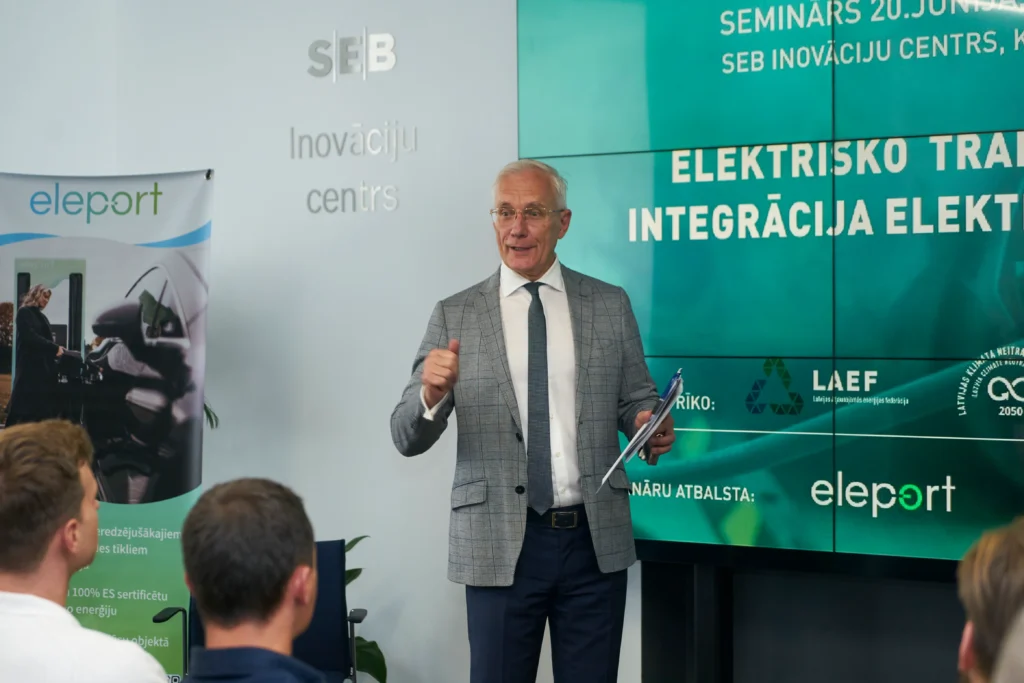
The seminar “Integration of Electric Vehicles into Power Grids and Buildings” was organized by the Latvian Climate Neutrality Cluster 2050 and the Latvian Renewable Energy Federation. This was the fourth event in the discussion series “More Renewable Energy, Fewer Emissions!”