
Amber Advisory follows the developments shaping business growth, investment decisions and competitiveness. The rapid growth of electric trucks in Europe is one such development – it affects not only vehicle choices, but also business infrastructure, energy consumption and long-term investment planning. In this article, we look at how the electric truck market is developing and what these trends could mean for Latvian businesses, including potential next steps for accessing public funding, representing industry interests, lobbying and conducting research that could help substantiate investment needs and contribute to a more supportive environment for businesses.
Electric Trucks Are Becoming a Real Market Segment
Electric trucks in Europe are no longer limited to individual pilot projects or technology experiments. In the first half of 2026, registrations of battery-electric heavy-duty trucks in Europe increased by 82.8%, indicating a significant acceleration in the market. In the second quarter of 2026, electric trucks accounted for 2.4% of all new heavy-duty truck registrations in Europe, compared with 1.4% in 2025. Although the overall share remains relatively small, the growth rate is what matters – as does the fact that electrification is becoming concentrated in markets and transport corridors where the necessary infrastructure and business demand are already emerging.
Global data shows a similar trend. The International Energy Agency (IEA) reports that global electric truck sales exceeded 400,000 units for the first time in 2025, doubling within a year. The heavy-duty truck segment is growing particularly rapidly, with sales almost tripling to approximately 230,000 vehicles. China is currently the main driver of market growth, but electric truck sales in Europe also increased by 40% in 2025.
Why Is Road Freight Becoming Increasingly Suitable for Electrification?
The advantages of electric vehicles in commercial transport are somewhat different from those in the passenger car segment. Trucks are used intensively, often travel long distances and represent significant costs for businesses in terms of fuel, maintenance and overall operation. Therefore, if an electric truck can deliver lower total costs on a particular route and under a specific operating model, the choice of technology becomes an economic rather than purely environmental decision.
This is where route predictability becomes particularly important. Electric trucks are especially well suited to operations where vehicles regularly return to the same base – for example, regional transport, logistics in ports and industrial areas, deliveries between company facilities or defined distribution routes. IEA data shows that such predictable operations are already among the key use cases for electric trucks, particularly in China.
The Biggest Question Is No Longer Just About the Truck
For a company considering the transition to electric trucks, purchasing the vehicle is only one part of the investment project. Charging infrastructure, available electricity capacity, electricity prices, route planning and vehicle utilisation are equally important.
This means that introducing electric trucks is increasingly becoming an energy and infrastructure project, rather than simply replacing one type of vehicle with another. A company may need to increase its grid connection capacity, install high-power charging infrastructure, deploy energy storage solutions or combine charging with solar power generation. As a result, transport electrification can become closely linked to the company’s broader energy strategy.
Europe Is Developing Regions Where Electrification Is Moving Faster
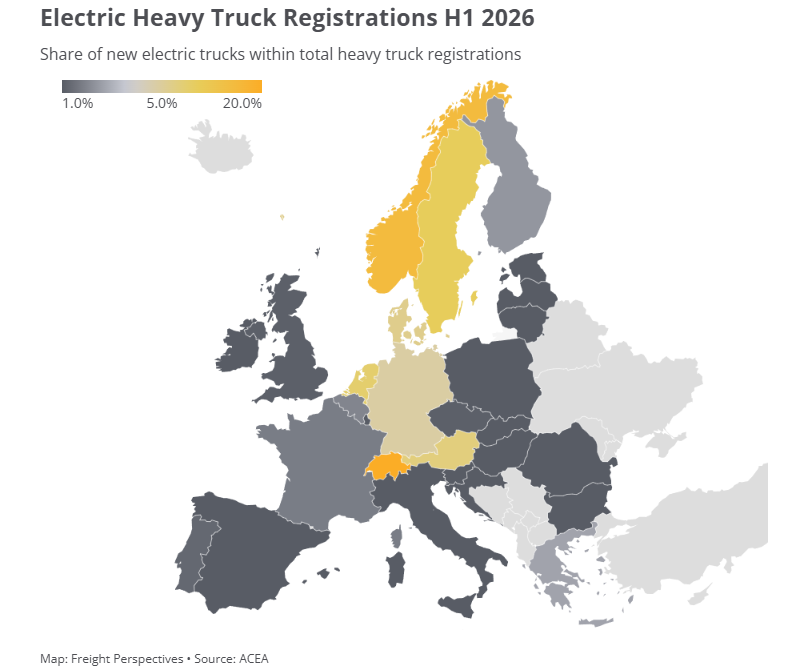
The European market is developing unevenly. According to Freight Perspectives, the growth of electric trucks is currently concentrated in certain markets rather than being evenly distributed across Europe. Switzerland is a particularly notable example – in the first half of 2026, electric trucks accounted for 21.3% of new heavy-duty truck registrations.
Meanwhile, IEA data shows that almost 17,000 electric medium- and heavy-duty trucks were sold in Europe in 2025, representing a 40% increase compared with the previous year. Growth is being driven by the availability of new models, European Union emissions requirements, national support mechanisms and the development of charging infrastructure. Germany, for example, approved €1.6 billion in funding for electric truck charging infrastructure.
For Latvian businesses, this is important not only in the context of the domestic market. Latvian transport companies operate along European transport corridors, and the future use of electric trucks will increasingly depend on the availability of infrastructure along entire routes. This means that companies planning to renew their fleets over the coming years should already be considering how customer requirements, transport corridors and cost structures may change.
Is an Electric Truck More Economical?
There is no universal answer. The initial purchase price of an electric truck can still be significantly higher than that of an equivalent diesel model. The IEA notes that in some markets, electric trucks can still cost two to three times more than their diesel alternatives. This remains a significant barrier, particularly for smaller transport operators.
However, the purchase price alone does not determine which vehicle is more economical for a business. What matters is the total cost of ownership (TCO) – including fuel or electricity costs, maintenance, vehicle utilisation, financing costs, residual value, road charges and potential public support. Such an assessment makes it possible to determine on which routes and under which operating conditions an electric truck may already be economically competitive.
Charging, Energy Storage and Business Infrastructure
One of the most interesting aspects is the connection between electric trucks and energy storage solutions. If several trucks in a company fleet need to be charged at the same time, electricity demand can become highly concentrated during specific periods of the day. This can create a need for greater grid connection capacity as well as potentially significant demand-related costs.
In such situations, businesses may benefit from considering a combined solution involving solar power generation, battery energy storage and smart vehicle charging management. This can turn fleet electrification into part of a broader corporate energy project. Companies planning to electrify their fleets should therefore assess their electricity infrastructure and potential energy storage solutions from the very beginning of the investment planning process.
What Does This Mean for Latvian Businesses?
The market for electric heavy-duty trucks in Latvia is still at an early stage of development, but European trends suggest that businesses do not necessarily need to wait until electric trucks become the dominant solution. On the contrary, an advantage may lie with companies that start evaluating their routes, fleets, energy consumption and infrastructure requirements early.
This could be particularly relevant for companies with large fleets, regular regional routes, logistics centres, manufacturing facilities and distribution infrastructure. For these businesses, electrification is not simply a question of purchasing a new vehicle – it can become a multi-year investment project requiring an assessment of transport costs, energy prices, grid connection capacity, charging infrastructure, financing opportunities and long-term regulatory developments.
Why Is It Worth Thinking About This Now?
The electric truck market has not yet reached a scale where a complete transition away from diesel can be expected. However, the pace of market growth shows that the technology is no longer simply a future scenario. Across Europe and other markets, an ecosystem of businesses, infrastructure and transport corridors is already emerging in which electric trucks are becoming a viable alternative in specific operating scenarios.
For Latvian businesses, this creates both challenges and opportunities. Companies planning fleet renewal and infrastructure investments over a multi-year horizon can already assess which routes could be economically suitable for electrification, what investments would be required for charging infrastructure, and whether transport electrification could be combined with solar power, energy storage or other energy-efficiency solutions. As electric transport moves closer to economic competitiveness, the key factor will increasingly be not the technology itself, but a company’s readiness to implement it in practice.