
The article was published on Diena.lv
Putin has gained a significant tactical victory. No, this is not about the presidential election of the Russian Federation, which was a technical process of moderate importance, but rather about the formation of the new government. The most odious representatives of the so‑called “liberal” clan have not been included. Thus—contrary to the views of certain Western experts who claim that Putin is losing power in his own country—the truth is entirely the opposite: Putin has gained new preconditions for further strengthening his power domestically.
DOWN WITH RUSSIA’S “LIBERALS”
The presidential election in the Russian Federation produced two significant outcomes. The so‑called “liberal” clan suffered a humiliating defeat, with all of the numerous liberal — the so‑called opposition — candidates together receiving around 2% of the vote. Some of these candidates are projects of the respective elite clan, clearly backed by the services. Secondly, the suddenly introduced Communist candidate received around 12% of the vote. This makes it clear that voters in Russia want a more left‑leaning policy, with at least some humane standard of living, while unequivocally rejecting Russia’s “liberals,” who — in the view of many analysts and citizens — have systematically plundered the country since the early 1990s (and who can only very conditionally be considered followers of liberal theory in the strict sense of the term). These election results alone, of course, are not sufficient for the elected president to implement substantial changes in policy.
The “liberal” clan in Russia has held influence over the country — particularly over its economic and privatization policies — since the time of Yegor Gaidar in the early 1990s (the history of how the security services shaped this elite group during the late Soviet period lies outside the scope of this article). This clan has consistently been protected by leaders of the global liberal elite — and institutions such as the International Monetary Fund — operating from Washington. In this respect, especially in financial policy, the Russian Federation has long been, in effect, highly pro‑American, as it has systematically supported the U.S. dollar. Several of Gaidar’s associates still hold high positions, dutifully carrying out directives that often harm the Russian Federation’s economic and financial sectors. A symbolic blow to this liberal group came a year and a half ago as a result of its own special operation, when — for corruption, what else? — the Minister of Economic Development, Ulyukayev, was arrested. Now, in May, the situation has shifted for at least five reasons: Trump in the United States is successfully waging a war against the liberals; voters in Russia have turned away from pro‑Western “liberalism”; Putin has strengthened his position thanks to increased foreign‑policy influence; the Americans (and, to a lesser extent, the British) are putting pressure on Russian oligarchs, reducing their influence; and most importantly — Putin is demonstrating achievements in the development of new weaponry. As a result, Putin can afford not to include the flagship figures of the “liberal” clan — Shuvalov, Dvorkovich, and several others — in the government, thereby gaining the opportunity to expand his power within the country, finally also in the economic and financial sectors. During previous presidential terms, Putin did not have the authority to intervene in economic and financial policy due to the “agreements” and balance of power among the various elite groups.
As a result of the agreements among the elite groups at the time, he was appointed president almost 20 years ago, even though he was not the first candidate considered for the role. Looking back at these years, it can be concluded that he has influenced the balance among the elite groups — if at all — only very cautiously and slowly, so as not to trigger mass aggression within the country. The group of people who held power in Russia two decades ago is not only no longer unified — over the past decade, the internal conflicts among elite factions have intensified, with the president largely distancing himself from them until now. A certain dividing line emerged around the time of the war in Georgia, after which more visible changes began. While in domestic politics he often distanced himself from clan conflicts and at times stepped in as a kind of “arbiter,” in foreign policy he repeatedly warned the West publicly that under his leadership Russia would try to avoid once again approaching the brink of disintegration and collapse, as it did in the 1990s, and would instead promote the country’s development. He asked the West to acknowledge that Russia would henceforth follow its own interests.
Many in Europe — though not all — understand the true role and significance of the Russian Federation. In recent days, during his visit to Russia, French President Emmanuel Macron considered it necessary to acknowledge that Russia now holds a new and, in certain areas, indispensable role in international relations, and he expressed hope that the Russian Federation would take into account the interests of France and its partner countries. He offered Putin the opportunity to jointly develop new approaches in international politics and in multilateral formats, noting that the West has, it seems, violated the understandings reached with Russia in the early 1990s. Macron’s remarks were unusually candid.
INDEED, AGAINST THE DOLLAR?
With the above‑mentioned preconditions alone, it is still not enough for the president of Russia to begin shaping economic and financial policy truly in Russia’s interests. What is additionally needed are reliable officials who will not engage in sabotage, as they have until now, and who possess the necessary governance expertise. It is also essential to have a clear understanding of how exactly to reform the country’s financial and credit policy — including, first and foremost, increasing the volume of credit available to businesses. Over the past couple of years, as a result of decisions made by the national bank, businesses have had almost no access to credit resources. Meanwhile, the so‑called currency “speculators,” both from the Russian Federation and the United States, have been able to enjoy record profits. This is one of the main reasons for the economic downturn, even though the country’s growth potential is considerable.
At present, the president of the Russian Federation has chosen a more tangible method — he has assigned tasks to the government and expects corresponding results in the autumn. Those who fail to deliver results in the autumn will face reprisals, for example, being asked by the tax authorities to prove the lawful origin of their income. This could serve as a clear motivation for officials and ministers. However, the president also defined tasks for the government in recent years, and the government calmly sabotaged them. We will soon see whether this time will be different.
The tasks are enormous — to restrict cross‑border currency flows (especially in the area of currency “speculation”), to significantly increase the amount of money available for business lending, and to reduce the current complete dependence on the dollar.
Russia is not ready to implement these measures today, yet the direction of movement is being outlined.
A few days ago, a draft law was submitted to the Russian parliament that would prohibit investing money from the National Welfare Fund in U.S. securities. The argument is that such investments pose a risk of the funds not being recovered.
This is not the first link in the chain — Iran already in 2012 began reducing the role of the dollar in its economy, and by 2018 fully banned its use in import transactions. Over the past year, China has started using its own currency in oil trade, thereby reducing the dollar’s influence. Even the European Union has recently allowed its trade with Iran to be conducted not in dollars but in another currency. Putin has just offered the same approach to Japan. In the near future, it will become clear whether these are unrelated developments or part of a broader plan — and whether the owners of capital will react aggressively enough.
In the coming months, central attention should be paid to how the struggle over Russia’s financial resources will unfold — specifically, whether Putin will succeed in redirecting financial policy in Russia’s interests, including within the country’s banking sector.
In international politics — at least in the current round — Putin has gained certain assets, and not weak ones. As the latest example, one can mention the statement made in Moscow on April 3 by General Wei Fenghe of the People’s Liberation Army of China, who publicly declared that his visit to Moscow was intended as a signal to the Americans about the increasingly close military cooperation between China and Russia. Apparently, the Chinese had doubts as to whether everyone was truly aware of this reality. It so happened that this announcement was made a day or two before the American and allied strike on Syria.
Sustained development has been achieved in Russia’s armaments production sector and in the Main Intelligence Directorate, and attempts to ram or undermine them have been prevented.
Thus, through both foreign‑policy and security‑policy instruments, as well as through the mandate gained in the elections and the support of a large part of the elite groups, the president of the Russian Federation has created a freer space for central economic and financial reforms. For now, it is not a major obstacle that there is no answer to the question “towards what,” that there is no “grand idea” or strategy. Nor is resistance from the West particularly disruptive — especially given that the West currently has more internal contradictions than unity.
Resistance to Putin’s regime in the West seemingly continues to grow. Sanctions will most likely be expanded, and interested parties will attempt to build Russia’s isolation, masking their true material interests behind it. Yet, examples such as Bulgaria’s recent offer to Russia to construct a Gazprom gas pipeline to Bulgaria suggest that the seemingly monolithic front against Russia is, in fact, porous.
IN THE STRUGGLE AGAINST PRESIDENT PUTIN — BUT IS IT TRULY A UNIFIED ONE?
The British Parliament has recently prepared a report titled Russia’s Gold, calling for the United States and the EU member states to synchronize their actions with the aim of closing Russia’s access to the international capital market. This is presented as a response to the flow of “dirty money” from the Russian Federation, and the fight against it is to become a priority of London’s foreign policy. The Americans have very recently instructed the British to stop servicing Russian oligarchs in London’s banks. At the same time, the United States and the United Kingdom are intensively urging European capitals to expand the so‑called Magnitsky list and to shut down all channels for the flow of dirty money from Russia.
The enthusiasm of Europe’s capitals in this regard will indicate on which side of history each of them stands.
If the British consider it appropriate to verify the lawful origin of the funds belonging to those Russian oligarchs who have invested at least fifty thousand pounds in the United Kingdom, then it is difficult to understand why other relevant EU member states could not do the same, in solidarity and in the name of security. The British could subject fewer than a thousand Russian citizens or former citizens labelled as oligarchs to such scrutiny. Proportionally, it is easy to assume that American financial intelligence services must have “files” on several tens of thousands of Russian individuals who could be subjected to sanctions whenever necessary.
So far, however, there is no indication that Western pressure on Russian oligarchs is leading toward Putin’s removal. Yet the West possesses an unimaginably broad range of economic and financial leverage. Breakthrough or catastrophe — the struggle is not over; it is the responsibility of all of us, and no one should remain on the sidelines.
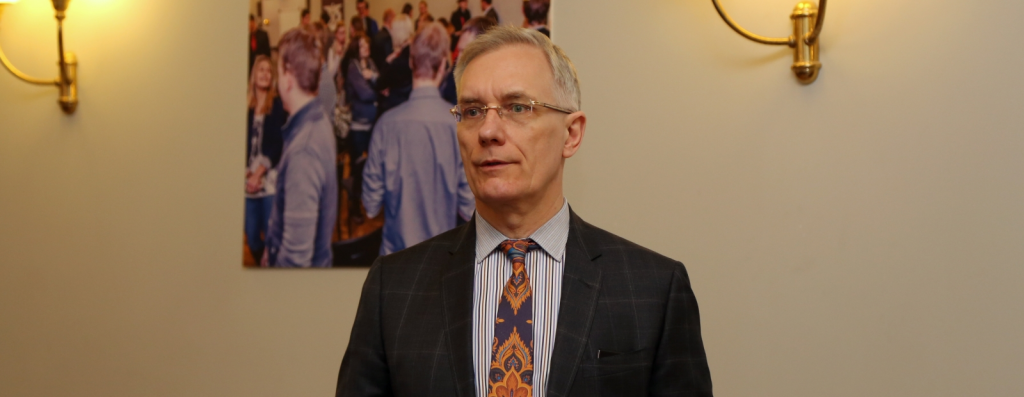
Photo: LETA