
On April 25, a seminar titled “Micromobility and Car Sharing in Cities—New Tools for Achieving Climate Neutrality Goals” took place at the European Union House in Riga as part of the discussion series “More Renewable Energy, Fewer Emissions!” This was the third discussion in the series, dedicated to climate neutrality goals in Latvia and organized by the “Latvian Climate Neutrality Cluster 2050” and the “Latvian Renewable Energy Federation.”
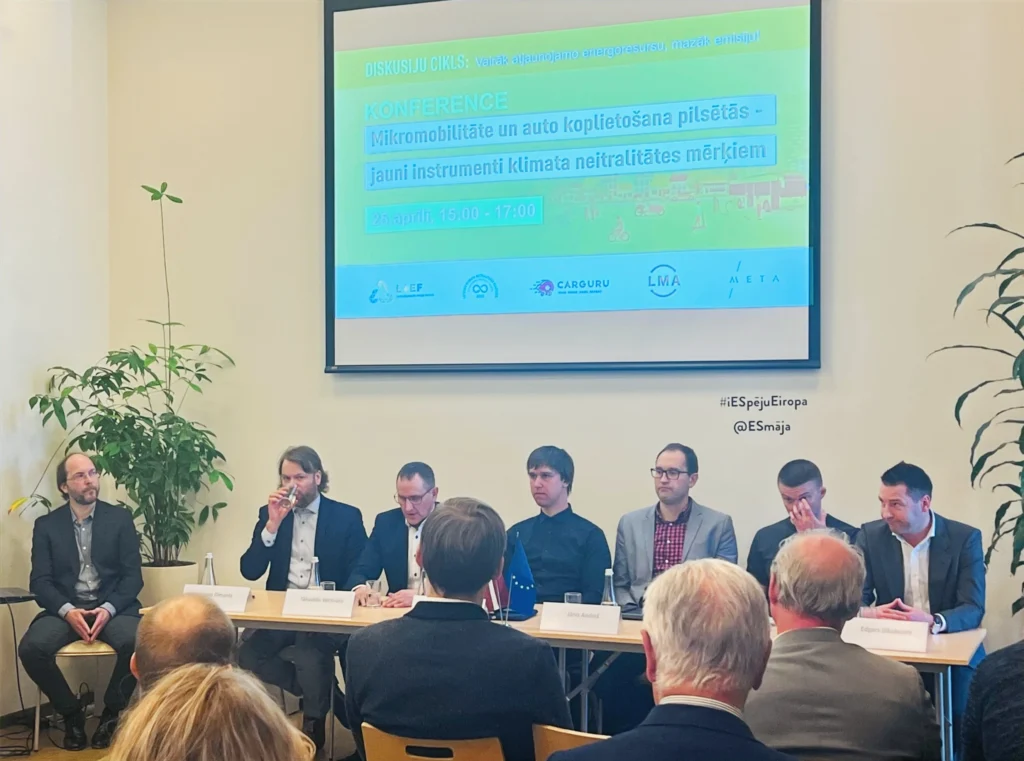
Conference speakers. Photo: Meta Advisory Latvia
Micromobility tools—such as scooters, bicycles, e-scooters, and others—as well as car-sharing services have become part of the daily lives of city residents. Their use is growing rapidly. They are replacing private cars and contributing to climate neutrality goals, which are particularly important right now as cities are required to develop their own climate neutrality plans. Latvia has gained its first experience with these new transportation solutions, so the government, local government institutions, and industry representatives are invited to discuss how best to promote the development of this sector, how to encourage user behavior, how to ensure the safety of road users, and how to optimally integrate these vehicles into the overall flow of urban traffic and pedestrian traffic.

Justs Dimants. Photo: http://foto.lu.lv/arhiivs
Dr. oec., climate researcher Justs Dimants emphasized during the discussion that GHG emissions in the European Union decreased by an average of 32% between 1990 and 2020, but a 7% increase was observed in the transportation sector. Micromobility and car-sharing services are among the tools that can be used to reduce CO2 emissions; they would also contribute to lower energy consumption, reduced traffic congestion, and improved air quality. To achieve this, support mechanisms at various levels, grounded in national policy, are necessary.
Tālivaldis Vectirāns, Director of the Road Infrastructure Department at the Ministry of Transport, outlined the country’s priorities in this area, including plans to develop micromobility infrastructure routes connecting populated areas with more than 5,000 residents and their 10-kilometer accessibility zones. When describing micro-mobility infrastructure in Latvia, it must be noted that its development has been fragmented; it is not well-integrated, and urban planners and consumers alike hold car-centric views.
J. Dimants cited several CO2 reduction measures in urban areas through the use of micromobility options (*): an average person who switches from driving a car to riding a bicycle reduces their life-cycle CO2 emissions by 3.2 kg of CO2 per day; by choosing a bicycle or e-bike instead of a car just once a day, the average resident’s transportation-related carbon emissions can be reduced by 62%; If one in five city residents were to change their travel habits in this way in the coming years, it would help reduce emissions in the transportation sector by approximately 8%.
Vladimirs Reskājs, CEO of “Carguru,” highlighted the contribution of car-sharing to achieving climate goals in the transportation sector: “Car-sharing is the future of ‘smart’ transportation and a comfortable urban environment free of traffic jams and stress. Furthermore, it encourages the use of other modes of transportation, such as bicycles, scooters, and public transit. Both the city and its residents benefit, as this ensures a better quality of the environment.”

Armands Gūtmanis Photo: Meta Advisory Latvia
Summarizing the main conclusions of the discussion, Armands Gūtmanis, director of the Latvian Climate Neutrality Cluster, said: “Today’s discussion clearly showed that both forms of mobility—shared transportation and micromobility—have grown rapidly, are actively used by consumers, and make a significant contribution to reducing emissions. They are important tools for achieving the climate policy goals set out in EU directives. There are not many such tools in the field of urban transportation—cities can consider establishing low-emission zones, promote shared transportation and micromobility, and make greater use of zero-emission public transportation. Local governments—first and foremost, Riga—should take these two mobility tools into account and support them in order to achieve climate goals.”