
Article published on tvnet.lv
On Tuesday, at the seminar “Integration of Electric Vehicles into Power Grids and Buildings,” organized by Meta Advisory Latvia in collaboration with the Latvian Climate Neutrality Cluster and the Latvian Renewable Energy Federation, Gunārs Valdmanis, Director of the Energy Market Department at the Ministry of Climate and Energy, stated that Latvia’s power grid is ready for the growth in electric transportation.
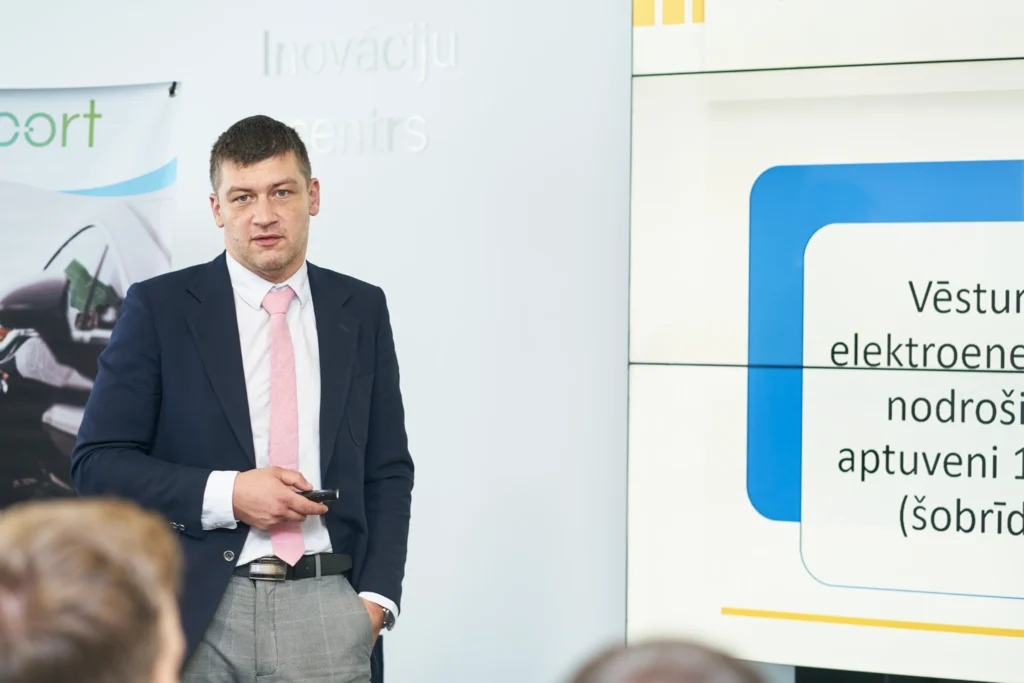
He explained that the current actual load on the power grid is below its capacity.
If current transportation usage patterns and volumes persist, the projected electricity demand could reach 2.7 terawatt-hours, compared to the 7.3 terawatt-hours that Latvia’s residents currently consume annually.
“In principle, the existing infrastructure is sufficient to meet this demand,” said Valdmanis, adding that, at the same time, the load depends significantly on the policy for the technical development of the charging infrastructure and on how consumer habits evolve. The ministry representative also noted that the current electricity tariff structure is more favorable for slow charging. He also noted that, overall, the actual competitiveness of electric vehicles can vary greatly among different users; however, unlike fuel prices, electricity prices on the exchange can sometimes even be negative.
Meanwhile, Jānis Andiņš, the Riga City Council’s chief project manager for transportation planning, pointed out at the seminar that Riga’s goal is to provide a total of 3,400 charging stations in the capital by 2030, and 10,800 by 2035.
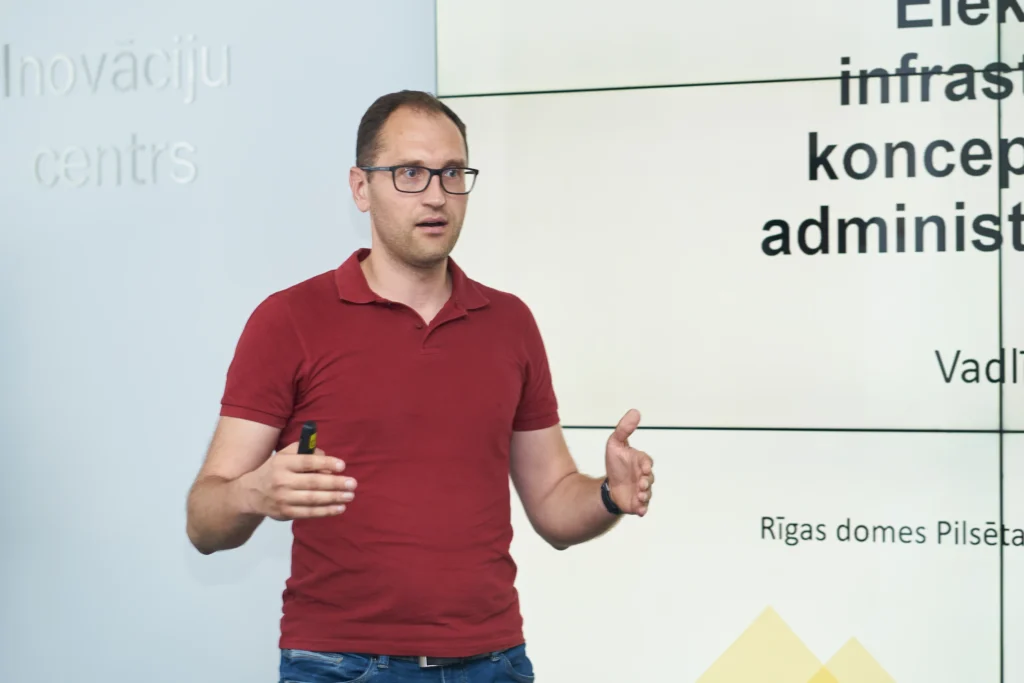
In accordance with the municipality’s objectives, as outlined in the draft concept for the development of an electric vehicle charging infrastructure network, charging stations will be located both in central Riga and in its neighborhoods. The only area where charging stations are not planned is Old Riga.
Andiņš noted that electric vehicle charging points are planned to be installed throughout Riga, both along streets and in designated parking areas. There are also plans to promote the availability of electric vehicle charging stations near shopping centers and other key locations.
Approximately 15% of the total number of charging stations are planned to be placed on streets, installed in existing parking lots along the edges of roadways. In total, approximately 200 charging points need to be installed annually to achieve the set goals, said a representative of the Riga City Council.
Commenting on proposals for providing charging stations, Andiņš said that the Riga City Council has developed two scenarios. One of them involves announcing an open lease tender for charging locations, while the other involves the municipality establishing its own commercial company. Given that in the latter case the municipality could be accused of interfering in the market, Andiņš noted that a tender for electric vehicle charging stations will most likely be competition.
At the same time, to increase the availability of charging stations on private land and in public spaces, proposals have been made within the municipality to reduce property taxes for landowners or to subsidize the installation of slow-charging stations.
Andiņš also said that Riga plans to develop charging points for micromobility vehicles, such as electric scooters.
Kārlis Mendziņš, head of “Eleport Latvia”, noted during the seminar that the company faces several challenges in promoting electromobility, such as a lack of public understanding, difficulties with electrical connections at certain locations in Latvia, and payment procedures for the service.
Overall, he explained that global demand for electric vehicles is currently growing steadily, and this upward trend is expected to continue in the future.
To keep pace with demand and future projections for the growth in the number of electric vehicles, the head of “Eleport Latvia” revealed that the company plans to invest approximately 100 million euros to become the largest charging network in Central and Eastern Europe. The first charging stations are scheduled to open soon in Poland, followed by the Czech Republic and Slovakia.
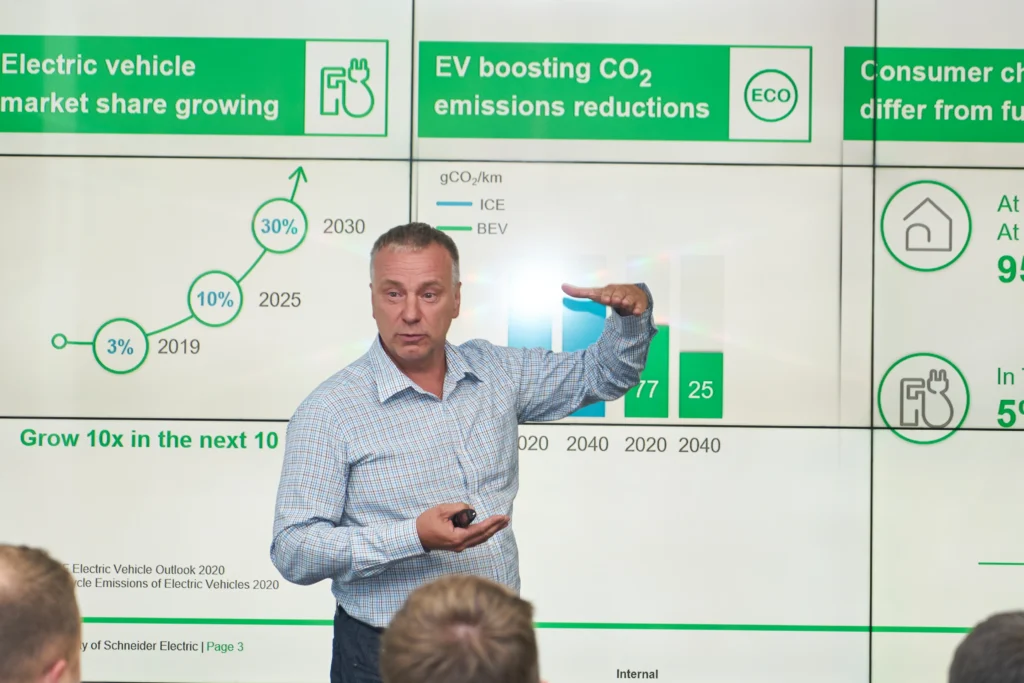
Meanwhile, Gatis Arājums, Product Development Manager for the Baltic States at Schneider Electric, revealed during the seminar that the company is currently expanding its production facility so that, by the end of the year, all of its products will be manufactured and tested in Riga.
Lasīt rakstu tvnet.lv