
The European Union has set a target to reduce net greenhouse gas emissions by at least 55% by 2030 compared to 1990 levels and to achieve climate neutrality by 2050. To reach these goals, climate and energy policy are increasingly being linked to investments, infrastructure development, energy efficiency, and sustainable economic growth. In the EU’s 2021–2027 programming period, climate, energy efficiency, and sustainable development have been assigned a significant role, while growing attention is also being paid to the next EU multiannual financial framework after 2027 and the investment priorities that will be established within it.
In this process, municipalities play a crucial role. Their decisions directly affect energy efficiency, transport, building infrastructure, district heating systems, territorial development, and other areas connected to emissions reduction and climate resilience. For municipalities, this represents not only an opportunity to attract substantial public funding but also a need to define development priorities in a timely manner and prepare for future investment opportunities. The interaction between sustainability, climate policy, public financing, and decision-making processes is increasingly becoming an important issue for companies and organizations operating in this field or seeking to contribute to its development.
To better understand this situation, Amber Advisory conducted a review of all publicly available climate and sustainability planning documents from Latvia’s 43 municipalities to assess how prepared municipalities are to implement long-term sustainability, climate, and emissions reduction goals. This research helps provide a better understanding not only of the differences between municipalities, but also of how climate and sustainability priorities are translated into concrete investments, funding opportunities, policy decisions, and cooperation needs. These are areas where both data-driven research and strategic consulting and advocacy play an essential role.
Should Municipalities Plan for Sustainable Development?
The European Union has established a legally binding target to reduce net greenhouse gas emissions by at least 55% by 2030 compared to 1990 and to become climate-neutral by 2050. These objectives are enshrined in the European Climate Law and implemented through the “Fit for 55” policy package.
Latvia has also set ambitious climate and energy goals. The updated National Energy and Climate Plan for 2021–2030 establishes a target of reducing total greenhouse gas emissions by 65% by 2030 compared to 1990 levels, while continuing the pathway toward climate neutrality by 2050.
However, achieving climate goals does not take place only within ministries or in Brussels. A significant share of decisions affecting emissions levels and climate resilience are made by municipalities. Municipalities are responsible for territorial development planning, public transport organization, management of public buildings, investments in energy efficiency, street lighting, heat supply systems, and urban development.
Moreover, substantial public funding is available in Latvia for achieving climate goals through EU funds, the Recovery and Resilience Facility, the Modernisation Fund, the Cohesion Fund, and other climate and energy efficiency support programmes. Within the EU Cohesion Policy Programme for 2021–2027, climate neutrality, climate change adaptation, and environmental protection are among the key investment priorities.
However, attracting and effectively utilizing funding requires not only specific project ideas but also a clear strategic vision for municipal development.
This raises an important question: Do Latvian municipalities have a clear and publicly available plan for achieving sustainability, climate neutrality, and emissions reduction goals?
Key Findings: How Municipalities Plan for Sustainable Development
To answer this question, we evaluated the climate readiness of Latvian municipalities by analysing publicly available municipal planning documents. The assessment focused on the existence and accessibility of Sustainable Energy and Climate Action Plans (SECAPs), climate plans, and climate neutrality documents available through official municipal information sources.
First, comprehensive climate planning remains relatively uncommon among Latvian municipalities. Of the 43 municipalities assessed, only five were found to have at least four of the five types of documents analysed, while a complete set of documents was identified in only two municipalities.
Second, more than half of the municipalities had only two of the five document categories reviewed. This indicates substantial differences in the level of climate governance and strategic planning across municipalities.
Third, several municipalities have already integrated climate issues into broader development planning, including energy efficiency, mobility, infrastructure, territorial development, and investment planning. This suggests that climate policy is not always presented as a separate document but may be embedded in other municipal planning instruments.
How Did We Assess Municipal Climate Readiness?
To evaluate the readiness of Latvian municipalities to implement climate goals, we analysed publicly available climate and development planning documents from all Latvian municipalities, including both cities of national significance and municipal districts.
The research involved reviewing information published on official municipal websites, development planning documents, climate action plans, public reports, and other available sources. Priority was given to official municipal publications and publicly available documents.
The assessment focused on three key climate governance criteria:
Sustainable Energy and Climate Action Plan (SECAP)
We examined whether municipalities had developed a Sustainable Energy and Climate Action Plan containing specific measures for reducing greenhouse gas emissions and adapting to climate change.
Climate Plan
We also reviewed the existence of other climate planning documents where these could not be classified as SECAPs or where they addressed broader climate policy issues.
Climate Neutrality Document
In addition, we assessed whether municipalities had developed documents specifically focused on achieving climate neutrality or net-zero emissions targets in the long term.
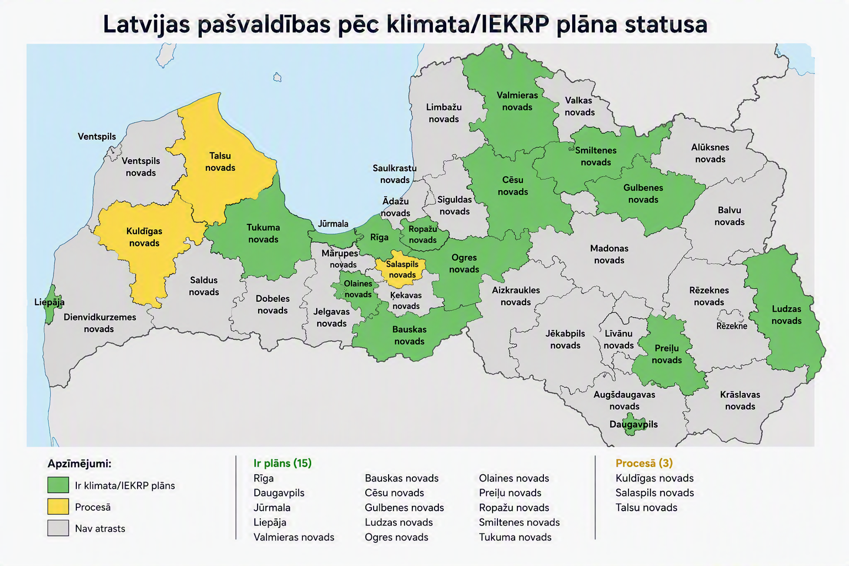
While several municipalities have already developed Sustainable Energy and Climate Action Plans, in other cases such documents are either under development or could not be identified in publicly available sources.
At the same time, our assessment indicates that climate issues are gradually becoming an integral part of municipal development planning. In several municipalities, climate mitigation and adaptation measures are already being considered alongside questions of energy efficiency, mobility, infrastructure, and territorial development.
What Drives Sustainability Planning in Municipalities?
Municipalities that participate in international initiatives, European Union projects, or have deliberately strengthened their energy and climate governance tend to be particularly active in this area.
In such municipalities, climate plans serve not only as environmental policy instruments but also as a foundation for investment planning, attracting external funding, and achieving long-term development objectives. Our findings suggest that the existence of climate planning documents is often linked to broader municipal development capacity. Municipalities with identified Sustainable Energy and Climate Action Plans typically define more concrete emissions reduction, energy efficiency, sustainable mobility, and climate resilience targets.
This creates more favourable conditions for investment planning and for leveraging various financial instruments, including EU funds and climate finance opportunities.
Climate Planning Is Already Part of Municipal Development Planning
Importantly, municipal development planning is not merely a voluntary choice. The Territorial Development Planning Law requires local governments to develop coordinated territorial planning documents, including a Sustainable Development Strategy, Development Programme, and Territorial Plan. The law stipulates that municipalities must define their long-term development vision, strategic objectives, and priorities within the Sustainable Development Strategy, while medium-term priorities, actions, and investment plans are established through the Development Programme.
This means that climate and sustainability issues cannot be viewed separately from overall municipal development planning. They are increasingly becoming part of decisions concerning municipal investments, project implementation, resource allocation, and long-term development pathways.
Nevertheless, our assessment also highlights significant differences between municipalities. In many cases, climate-related issues remain integrated within broader development documents rather than being formulated as dedicated climate policies or action plans. This makes it more difficult to compare municipalities and assess progress over time.
From Climate Targets to Investments
It is important to emphasize that climate planning is not only about reducing emissions. Increasingly, it is becoming a matter of development and competitiveness. Municipalities must be able to plan more energy-efficient infrastructure, adaptation to extreme weather events, sustainable mobility solutions, and more efficient use of resources. These issues directly affect both residents’ quality of life and municipalities’ ability to attract investments and secure funding for future projects.
This topic is especially relevant today as the European Union is discussing and preparing the next multiannual financial framework after 2027, which will shape future investment priorities in climate, energy, environmental protection, and sustainable development. Municipal readiness for future funding opportunities is not simply a matter of having a climate plan. It is also about the ability to identify development needs in a timely manner, define investment priorities, justify their necessity, and align them with long-term climate and sustainability objectives. The more clearly these priorities are defined today, the better municipalities will be positioned to utilize opportunities under the next EU funding period.
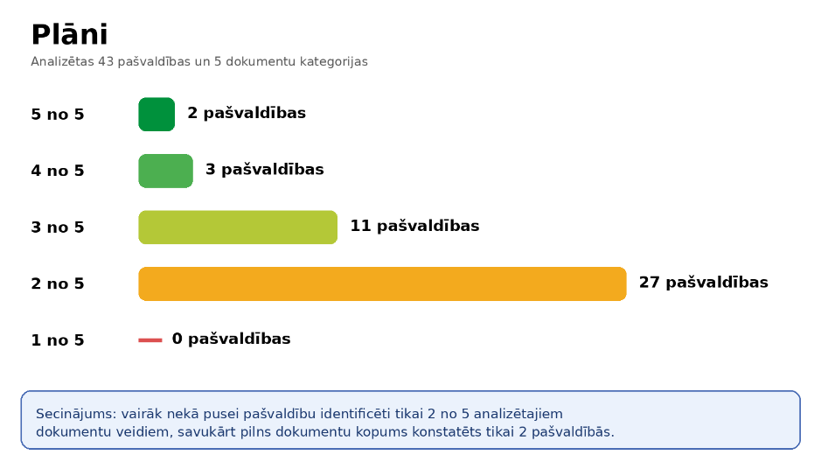
Overall, our assessment indicates that climate governance is gradually becoming a significant component of development planning within Latvian municipalities. At the same time, the prevalence and level of detail of climate policy documents vary considerably across municipalities.
This means that while national climate targets are shared, municipal preparedness to achieve them is uneven. In some municipalities, climate and energy issues are already linked to concrete investment and development decisions, while in others this connection is only beginning to emerge.
In the coming years, one of the most important challenges will be ensuring that climate governance becomes a systematic and practical development tool across all municipalities in Latvia, not merely a document, but a foundation for setting investment priorities, attracting funding, and making long-term development decisions.